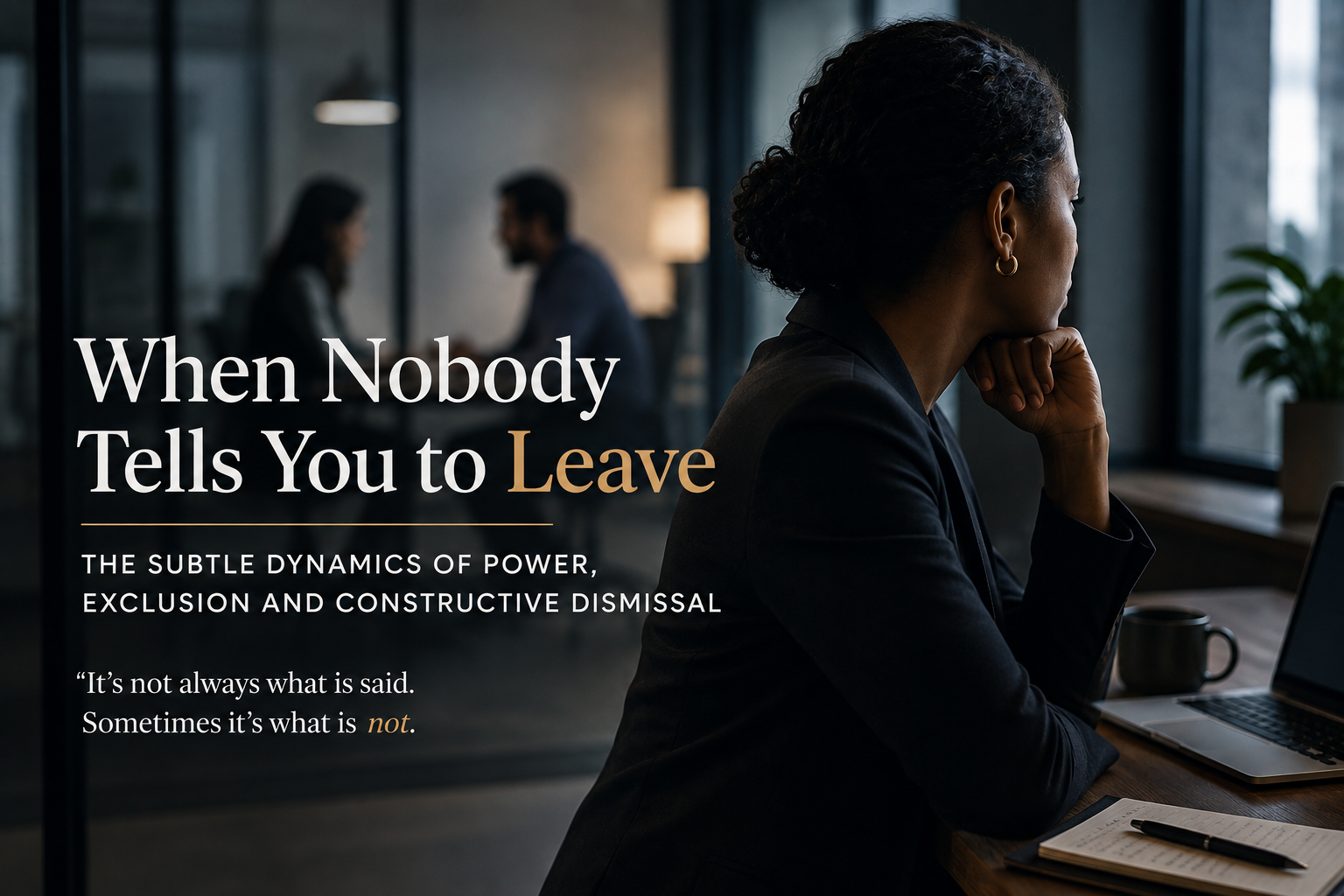
The Subtle Dynamics of Power, Exclusion and Constructive Dismissal
Sometimes, the most difficult workplace experiences are the ones you struggle to explain. You are still invited to meetings, still given work, still receive emails, and still included in the organisational structures that, from the outside, suggest everything is perfectly fine. Yet, something has changed.
You begin to feel that your presence is tolerated rather than valued. Your influence seems to diminish. Conversations happen differently. Opportunities that once felt accessible become less so. You become increasingly aware of how your manager responds to you, how others respond to your manager, and how quickly their interpretation of you seems to carry more weight than your own.
Nobody has told you to leave, but you begin to wonder whether they are hoping you will.
This is where the conversation becomes complicated.
The Experience Is Real, But the Evidence Is Not Obvious
Having worked across employee wellbeing and labour relations, I have become increasingly interested in the space between what an employee experiences and what they can actually demonstrate. There is an important distinction here.
An employee can genuinely experience a workplace relationship as undermining, exclusionary or increasingly intolerable. That does not automatically mean that the employer has committed constructive dismissal, nor does it necessarily establish unlawful conduct.
Under section 186(1)(e) of South Africa’s Labour Relations Act, constructive dismissal occurs where an employee terminates the employment relationship because the employer has made continued employment intolerable. The Constitutional Court recently reaffirmed that the enquiry remains an objective one and that the employee bears the onus of establishing that the employer’s conduct rendered continued employment intolerable (Maleka v Boyce N.O. and Others, 2026). This is precisely what makes subtle workplace dynamics so difficult. The experience can be profound, but the evidence can be fragmented.
When we imagine someone being pushed out of a workplace, we tend to imagine something obvious, a demotion, formal disciplinary process, responsibilities being removed, being explicitly told that your services are no longer required, but workplaces do not always operate so visibly.
Sometimes the changes are smaller. You are no longer consulted about matters within your expertise. Your suggestions receive less consideration. Your mistakes appear to carry more weight than those of others. You notice that your manager seeks the opinion of others before yours. You are technically included in meetings, but your contribution seems increasingly peripheral. Opportunities begin passing you by without an explanation that feels convincing. None of these things, in isolation, necessarily proves an attempt to force someone out. That is precisely the difficulty.
This is where my work in social work supervision has shaped the way I think about workplace relationships. My research into harmful interpersonal power dynamics in social work supervision highlighted how organisational position, experience, professional hierarchies and interpersonal relationships can influence how power is exercised and experienced within supervisory relationships (Modise, 2025). Supervision is, by its nature, a relationship with an inherent power differential. The supervisor has formal authority, while the supervisee is positioned within a relationship where assessment, guidance, professional development and organisational expectations intersect. That power matters.
It matters because the person with greater organisational authority often has greater access to information, greater influence over how situations are interpreted and, importantly, greater credibility within the organisation. Imagine two people offering competing accounts of the same workplace interaction. One has been with the organisation for ten years. They know the systems, the people. and they have established relationships and a history of being trusted. The other has been there for considerably less time. Both may technically have a voice. But they may not have the same power to have that voice believed. That is an important distinction. Power does not always operate through explicit instructions. Sometimes it operates through whose interpretation becomes the accepted version of events.
One of the key insights from my research was that power is not exercised only through formal authority. It is also shaped by credibility, access to information, organisational relationships and whose interpretation of events becomes accepted as legitimate (Modise, 2025). These dynamics are not limited to social work supervision; they can emerge across a range of workplace relationships.
Supervisors do not have to openly dislike an employee for a difficult interpersonal dynamic to develop. Sometimes it is communicated through much smaller behaviours like who gets asked for an opinion, who receives informal information, who gets encouraged, who receives the benefit of the doubt, whose mistakes are remembered, who is described as “difficult”, who is described as “reliable”, who is given opportunities to demonstrate their capabilities, or who is scrutinised more closely. Again, none of these observations automatically establishes misconduct, but patterns matter.
Research on workplace ostracism and supervisor behaviour increasingly demonstrates that exclusion does not have to be dramatic to have consequences. Workplace ostracism has been associated with employee silence and reduced job performance, suggesting that exclusion can affect both employee wellbeing and organisational effectiveness (Abubakar, Foroutan, & Megdadi, 2021). Research has also linked unsupportive supervisory relationships to employee silence and reduced creative contribution, suggesting that employees who perceive interpersonal risk may become less willing to share ideas, challenge assumptions or participate fully in organisational life (Lee et al., 2022).
The important point is that employees do not necessarily need to be openly attacked to begin withdrawing. Sometimes they simply learn that speaking up is unlikely to change anything. This observation is reflected in contemporary organisational research, where workplace ostracism has been linked to both acquiescent silence and defensive silence, suggesting that employees may withhold information, concerns or ideas when they perceive exclusion or interpersonal risk (Khan et al., 2022; Abubakar et al., 2021)
This is the part we don’t talk about enough.
When you begin to believe that someone in authority has formed a negative perception of you, you may start monitoring yourself differently. You become careful about what you say, replay conversations, wonder whether a comment had another meaning, document interactions, become increasingly conscious of who was copied into an email, notice who was consulted, start wondering what has been said about you when you weren’t in the room. And because the person involved has organisational authority, the concern is not simply: “My manager doesn’t like me.” It becomes: “What does my manager’s perception of me mean for how other people in this organisation see me?” That is a very different psychological experience.
This pattern is reflected in organisational research. Wang et al. (2020) found that employee silence may act as a mechanism through which problematic supervisory behaviour affects both engagement and job satisfaction. In other words, silence is not always disengagement; sometimes it is a response to the environment. Similarly, Xu et al. (2020) and Sridadi et al. (2022) found that abusive supervisory behaviour was positively associated with subordinate silence, reinforcing the idea that employees may become increasingly cautious about expressing concerns or opinions when they perceive interpersonal or professional risk. Silence, therefore, is not always disengagement, sometimes it is self-protection.
This distinction matters enormously.
From a labour-law perspective, feeling unhappy, excluded or undervalued does not by itself establish constructive dismissal. South African courts have maintained a relatively high threshold. The employee must demonstrate that the employer’s conduct made continued employment intolerable, and the enquiry focuses objectively on the conduct and circumstances rather than solely on how the employee experienced them. The Constitutional Court reaffirmed this approach in Maleka v Boyce in 2026.
This is why subtle workplace experiences can be so difficult. The employee may think: “Something is happening.” But the formal question may become: “What specifically happened, and can you demonstrate how the employer’s conduct made continued employment intolerable?” Those are not the same question, and sometimes the gap between them is enormous.
Why Documentation Matters
This is not about encouraging employees to build a case against their employer every time they have a difficult interaction. It is about recognising that when workplace concerns become persistent, contemporaneous records can help distinguish a pattern from a feeling that is difficult to reconstruct months later. If something concerning happens, employees may wish to keep factual records of:
- what happened;
- when it happened;
- who was present;
- what was said or communicated;
- what decisions were made;
- how the situation differed from established practice;
- whether concerns were raised;
- and how the organisation responded.
The emphasis should be on facts rather than interpretations. There is a significant difference between writing: “My manager is trying to get rid of me.” and: “On 14 August, I was informed that X responsibility would be reassigned. On 20 August, I asked for clarification regarding the reason for the change and was advised…” The latter creates something that can actually be examined. That distinction becomes particularly important if an employee later needs advice from HR, a union, a labour practitioner, the CCMA or another appropriate professional.
But, there is another side to this conversation.
If employees feel they need to constantly collect evidence just to establish that they are being treated fairly, something has already gone wrong in the employment relationship. Organisations should not rely on employees reaching breaking point before taking interpersonal concerns seriously. Managers should be encouraged to notice changes in relationships, HR should be willing to examine patterns rather than only isolated incidents, and employees should have psychologically safe avenues through which they can raise concerns before the situation becomes intolerable. Because by the time someone resigns and attempts to explain why they felt they had no reasonable option but to leave, the organisation may be looking at the final event while the employee is trying to explain everything that came before it.
Power requires responsibility, and perhaps this is the broader lesson. Power in the workplace is not inherently problematic. Organisations need structures, managers need authority, and supervisors need to provide direction and accountability. The more power someone has to influence another person’s professional experience, the greater the responsibility to use that power fairly, transparently and with self-awareness. A supervisor does not have to like every employee, a manager does not have to agree with every employee, and professional relationships do not require personal compatibility. But employees should not have to wonder whether a personal perception has quietly become a professional disadvantage.
My Final Thoughts
Not every difficult workplace relationship is constructive dismissal, not every exclusion is intentional, and not every change in behaviour represents an organised attempt to push someone out. Sometimes, what feels like a pattern may have explanations we cannot yet see, but, the absence of an obvious act does not mean the absence of an experience. And the fact that an employee is still invited to meetings, still assigned work and still appears included on paper does not necessarily mean that the relationship is healthy.
Perhaps we need to become more attentive to the space between formal inclusion and genuine belonging. Because sometimes, the workplace does not tell you to leave, it simply becomes a place where you increasingly feel that staying was never really the intention and by the time you begin considering the door, the story may have been unfolding quietly for much longer than anyone realised.
References
Abubakar, A. M., Foroutan, T., & Megdadi, O. (2021). Workplace ostracism and employee silence: An identity-based perspective. Kybernetes, 52(1), 97–120. https://doi.org/10.1108/K-04-2021-0306.
Lee, W.-R., Kang, S.-W., & Choi, S.-B. (2022). Abusive supervision and employee’s creative performance: A serial mediation model of relational conflict and employee silence. Behavioral Sciences, 12(5), 156. https://doi.org/10.3390/bs12050156.
Modise, T. (2025). The Management of Harmful Interpersonal Power Dynamics in Social Work Supervision (Doctoral dissertation, Stellenbosch University).
Sridadi, A. R., Admojo, R. T. C., Himmawan, M. F., & Fuciu, M. (2022). The effect of abusive supervision on employee silence with the mediation role of emotional exhaustion and moderate leader-member exchange. BISMA (Bisnis dan Manajemen), 15(1), 78–95. https://doi.org/10.26740/bisma.v15n1.p78-95.
Wang, C.-C., Hsieh, H.-H., & Wang, Y.-D. (2020). Abusive supervision and employee engagement and satisfaction: The mediating role of employee silence. Personnel Review, 49(9), 1845–1859.
Xu, Q., Zhao, Y., Xi, M., & Li, F. (2020). Abusive supervision, high-performance work systems, and subordinate silence. Personnel Review, 49(8), 1637–1653. https://doi.org/10.1108/PR-01-2019-0029.
South African legal sources
Labour Relations Act 66 of 1995, s 186(1)(e).
Maleka v Boyce N.O. and Others [2026] ZACC 7. Constitutional Court of South Africa.
Maleka v Boyce N.O. and Others — Constitutional Court judgment materials.